
Registration
- The course flyer with an overview of the program is here.
- The detailed program and curriculum will be distributed to CAS participants directly.
- For more information about the course please contact michael.thali@virtopsy.com.
- Please note that your registration can be definitely confirmed only upon receipt of payment.
Remarks regarding registration
We will not accept more than a certain number of registrants for each module of the course.
Course contact and questions
Please contact us in case you have any questions regarding the course!
Address
University of Zurich, Institute of Forensic Medicine
Course Administration for CAS (Certificate of Advanced Studies) Forensic Imaging and Virtopsy
Waltersbachstrasse 5
CH-8006 Zurich
Telephone: +41 (0)44 635 56 11
E-Mail of course director: michael.thali@virtopsy.com
E-Mail of course administration: virtopsy@irm.uzh.ch
Website: https://irm.uzh.ch
Course director
Prof. Dr. med. Michael Thali, Exec MBA, Full professor of the Institute of Forensic Medicine at the University of Zurich – michael.thali@virtopsy.com
Course coordinators
- 2027:
- Dr. med. Vasiliki Chatzaraki, Forensic Pathologist at the Institute of Forensic Medicine at the University of Zurich
- Dominic Gascho, MSc, MAS ETH, Technical Leader and Research Group Leader
- 2015 to 2026: Dr. med. Wolf Schweitzer, Forensic Pathologist at the Institute of Forensic Medicine at the University of Zurich
- 2014: PD Dr. med. Steffen Ross, Radiologist at the Institute of Forensic Medicine at the University of Zurich
- 2013: Prof. Dr. Garyfalia Ampanozi, Forensic pathologist at the Institute of Forensic Medicine at the University of Zurich
Upcoming courses
Dates and programs
Course dates APRIL 2027 23rd Virtopsy Course / 10th CAS Forensic Imaging & Virtopsy [updated program will be linked later, see previous year program for overview] Certificate of Advanced Studies (CAS) Modules: Module I: Basic Course: Mon 05.04.2027-Tue 06.04.2027 Module II: Advanced Course: Wed 07.04.2027 - Fri 09.04.2027 Module III: Practical Course: Mon 12.4.2027-Fri 16.04.2027 Note: without further notice, the visualisation pre-course will not be offered any longer |
Ongoing course
Course dates 2026 22nd Virtopsy Course / 9th CAS Forensic Imaging & Virtopsy Facultative Pre-Course: Part 0: Visualisation Pre-Course: Fri 6.3.2026 – program Certificate of Advanced Studies (CAS) Modules: Module I: Basic Course: Mon 9.3.2026-Tue 10.3.2026 – program Module II: Advanced Course: Wed 11.3.2026- Fri 13.3.2026 – program Module III: Practical Course: Mon 16.3.2026-Fri 20.3.2026 – program |
Comparing course parts
Course part / module | Virtopsy Basic Course | Virtopsy Advanced Course | Virtopsy Practical Course |
ECTS, CME | 1 ECTS; 2026: 13 CME credits by Swiss Society of Forensic Medicine | 1 ECTS; 2026: 21 CME credits by Swiss Society of Forensic Medicine | 8 ECTS; 2026: 31 CME credits by Swiss Society of Forensic Medicine |
Requirements | attendance of this module, | attendance and passing of prior module, | attendance and passing of prior modules, pass requirements by sitting course here, pass assignments [at course venue, practical course: 4 ECTS], complete a casebook of 50 cases [4 ECTS for casebook] (yielding 8 ECTS in total) |
Certificate | Certificate of Attendance (basic course completed) | Certificate of Attendance (advanced course completed) | Certificate of Attendance (practical course completed) Certificate of Advanced Studies (CAS) Forensic Imaging & Virtopsy by the University of Zurich, Switzerland (once all modules including casebook are complete) |
Course fee | 1300 CHF | 1900 CHF | 7300 CHF |
Registration | |||
Information | For more information and for registration please contact virtopsy@irm.uzh.ch | For more information and for registration please contact virtopsy@irm.uzh.ch | For more information and for registration please contact virtopsy@irm.uzh.ch |
General information about our Forensic Imaging / Virtopsy® course
Structure of the course
Virtopsy® has always been involved in delivering educational experiences to wide audiences. The last decade has seen an unprecedented increase in the adoption of these techniques in the field of forensic pathology.
The courses are offered as a CAS (Certificate of Advanced Studies) in Forensic Imaging & Virtopsy. The certificate is issued by the University of Zurich and can be obtained after completing all assessments and course modules.
The modules can be taken separately, but not in any order.
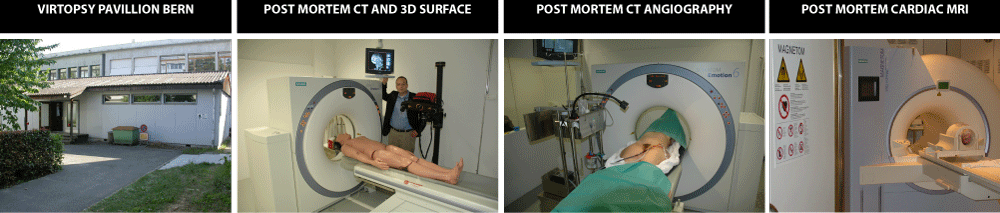
- The Virtopsy® Basic course (module I) consists of two days with a focus on post mortem CT (PMCT) with fully frontal lectures, and no workshop parts.
- The Virtopsy® Advanced course (module II) takes three days, and it will focus on more imaging (PMCT, post mortem MRI). Also, the Advanced course expands the subjects of the Basic course with more detail.
- The Virtopsy® Practical course (module III) then starts after module III finished, that is, it takes part during the following week.
Target audience
The CAS Forensic Imaging and Virtopsy® is aimed at all persons who are professionally interested or actively involved in forensic radiology and imaging, including forensic pathologists/medical examiners, radiologists, coroners, radiographers/radiology technicians, surveying specialists, and forensic anthropologists.
Memberships and accreditation
The course director and coordinator as well as many of the course presenters are members of the International Society of Forensic Radiology and Imaging (ISFRI). The ISFRI also works towards coordination across best practices, education, research, quality standards, certification as well as providing a journal for the members of the society, the Journal of Forensic Radiology and Imaging.
The course will be submitted for accreditation to the Swiss Society of Forensic Medicine for CME (Continuous Medical Education) credit points.
The course modules I, II and III are compulsory parts for the certificate of the University of Zurich; these are awarded ECTS points by the University of Zurich that count towards the CAS Forensic Imaging and Virtopsy. On top, to get the certificate, participants have to submit a casebook.
Remarks about the course subject choices that we made
- The course also introduces new technologies such as 3D-printing, 3D-visualization, and AI/Deep Learning. We have researchers that work in these areas and feel is relevant to show how these link into forensic imaging.
- The 3D surface documentation session is an addition that is regarded as particularly relevant because of a recent rise in surface documentation also in forensic science where crime scenes and scenes of traffic accidents are increasingly documented in full 3D. An introductory lecture is provided in module I, and a full day of instructions is performed as part of module 3.
Technical / skill requirements
A medical background is clearly assumed as laid out in the statutes of the University regarding this course.
Exceptionally, participants with other background may be admitted or sit in, by agreement, but this very clearly is a medical course aimed at people that practice or plan to practice forensic post mortem CT imaging.
Content of course parts
There is a Basic Course (2 days) and, immediately following, the Advanced Course (3 days) and a Practical Course (5 days).
Basic Course (module I)
This course covers general aspects of post mortem CT scanning.
We introduce basic concepts of forensic imaging for pathologists and basic concepts of forensic medicine for radiologists. A focus is on subjects such as e.g. natural death, sharp force injury, blunt force injury, drowning, thermal injuries, and CT-scanning protocols.
Advanced Course (module II)
This module addresses subjects such as strangulation, imaging of abuse and neglect, vital reactions, foreign bodies, and post mortem MR.
Practical Course (module III)
This module is geared towards actual users of post-mortem CT scanning and focuses on practical forensic CT reading and documentation.
The target audience for module 3 therefore will be people that are responsible for actually reading cases and generating forensic imaging reports.
So, module I and II are a requirement, as this module III is only for those that did the Virtopsy® Basic and Advanced Courses in the past. In addition to attendance of the course, assignments and tests need to be passed.
The course attendants will receive a Certificate of Attendance once they provided full attendance of the lectures of this course and passed attendance and assessments; prior attendance of the previous modules is a must. Four ECTS point is awarded.
Module content distribution across modules I, II and III
We offer training so that participants ultimately can achieve a Certificate of Advanced Studies in the field of Forensic Imaging. The title of “Certificate of Advanced Studies in Forensic Imaging and Virtopsy®” is issued by the University of Zurich.
While the pre-course only covers software use skills, modules 1 and 2 are thought as general introduction and method demonstration, and to give participants workshop-like hands on experiences about various aspects. The module III however gets participants into practical aspects.
The module III of the CAS Forensic Imaging course is also called “Virtopsy® Practical Course”.
Module III – target audience
Students of the CAS Virtopsy® are expected to have a Master’s degree in medicine from an accredited university and certification as a specialist in forensic medicine or radiology. In exceptional cases, persons with a Bachelor’s degree in a medical field from an accredited university and several years of work experience in radiology, or persons with an equivalent qualification may be admitted to the program.
Module III will be most useful to all those that start their own post mortem CT scanning service and want to learn how to make best use of the data.
Formal aspects
The CAS in Forensic Imaging of the University of Zürich, Switzerland offers a public academic University certificate in Forensic Imaging. Details are outlined in Regulations Governing the Continuing Education Program CAS in Forensic Imaging and Virtopsy® at the Faculty of Medicine, University of Zurich, Switzerland [pdf].
Most notably, this University certificate can only be issued if certain requirements are met. Graduates of the full CAS Forensic Imaging and Virtopsy® will be awarded a total of 10 ECTS points.
Requirements to be met are attendance of the course modules I and II and passing of the assessments there (both modules) (2 ECTS), the attendance of module III that contains the provision of practical project work (3 ECTS), and providing documentation for one real case in our institute under our supervision (1 ECTS).
A case book has to be submitted documenting 50 post mortem cases (4 ECTS).
Time-wise, the total days of actual presence required at our institutes is 5 days (for modules I and II formerly called Virtopsy® Course, which is an integral part of the CAS, or a requirement) and another 5 days for further course work of module III.
The case book that the participants will prepare may be done off-site (for example, at their own workplace) and it has to be submitted to the CAS course coordinator. It is suggested to provide and contain 50 (fifty) single case studies from the own caseload of participants.
The deadlines to submit the casebooks are given below.
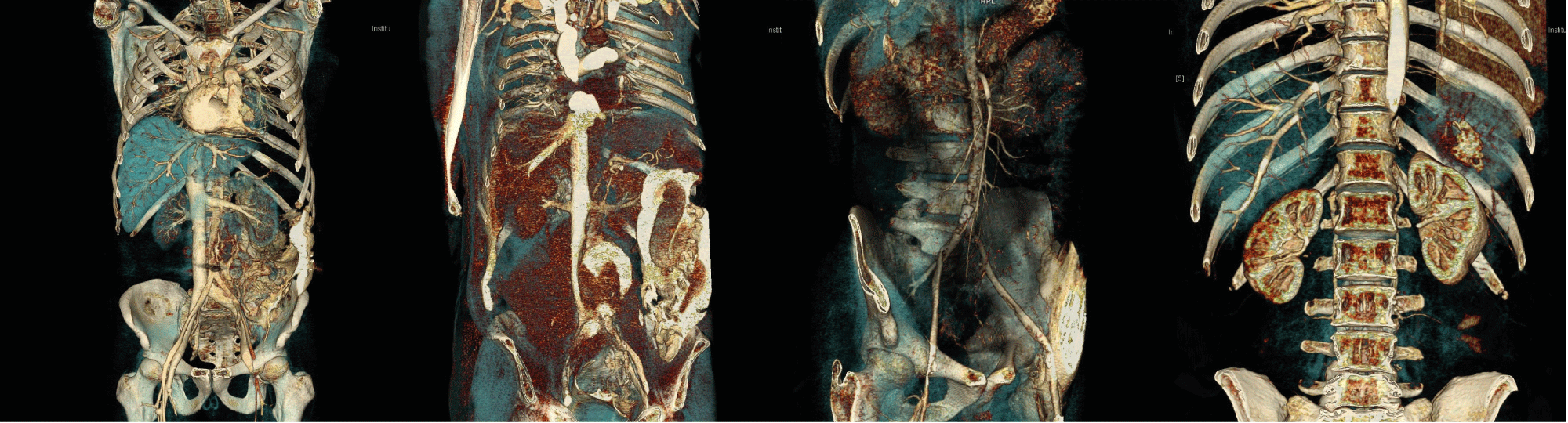
Module III – how to make a CAS casebook (50 cases)
Each participant has to prepare and submit a book containing 50 case descriptions. These then are assessed by the CAS Forensic Imaging and Virtopsy® course director.
The casebook is usually the last step in completing the studies necessary to obtain a CAS in Forensic Imaging & Virtopsy®. This does not have to be completed on-site – usually, participants make their casebooks from where they usually work.
The CAS for Forensic Imaging and Virtopsy® requires you to prepare a casebook containing 50 case studies. Preparing the CAS Forensic Imaging and Virtopsy® casebook may allow you to practice the preparation of PMCT evidence in a way that also authorities and courts can follow your descriptions.
Downloads:
[if the browser thinks the files cannot be downloaded try different browser, maybe FireFox rather than Edge]
Module III – reporting forensic PMCT cases
While we teach and mostly use straightforward tools (such as Microsoft Word and Powerpoint) to generate our written and visual reports, reports can have many forms.
Links to some online-form check-list type assistance and an article to help to understand the issues:
- Short Form (English)
- Long Form (English)
- Article about a check-list approach to structured reporting
Visual case documentation
The visual (and not only written) case documentation is a focus subject for this Forensic Imaging course that is pursued particularly in module 3, so that all participants can actively learn the relevant details. At the latest then, putting together a good case book of 50 cases for the last assessment should not pose technical obstacles any longer.